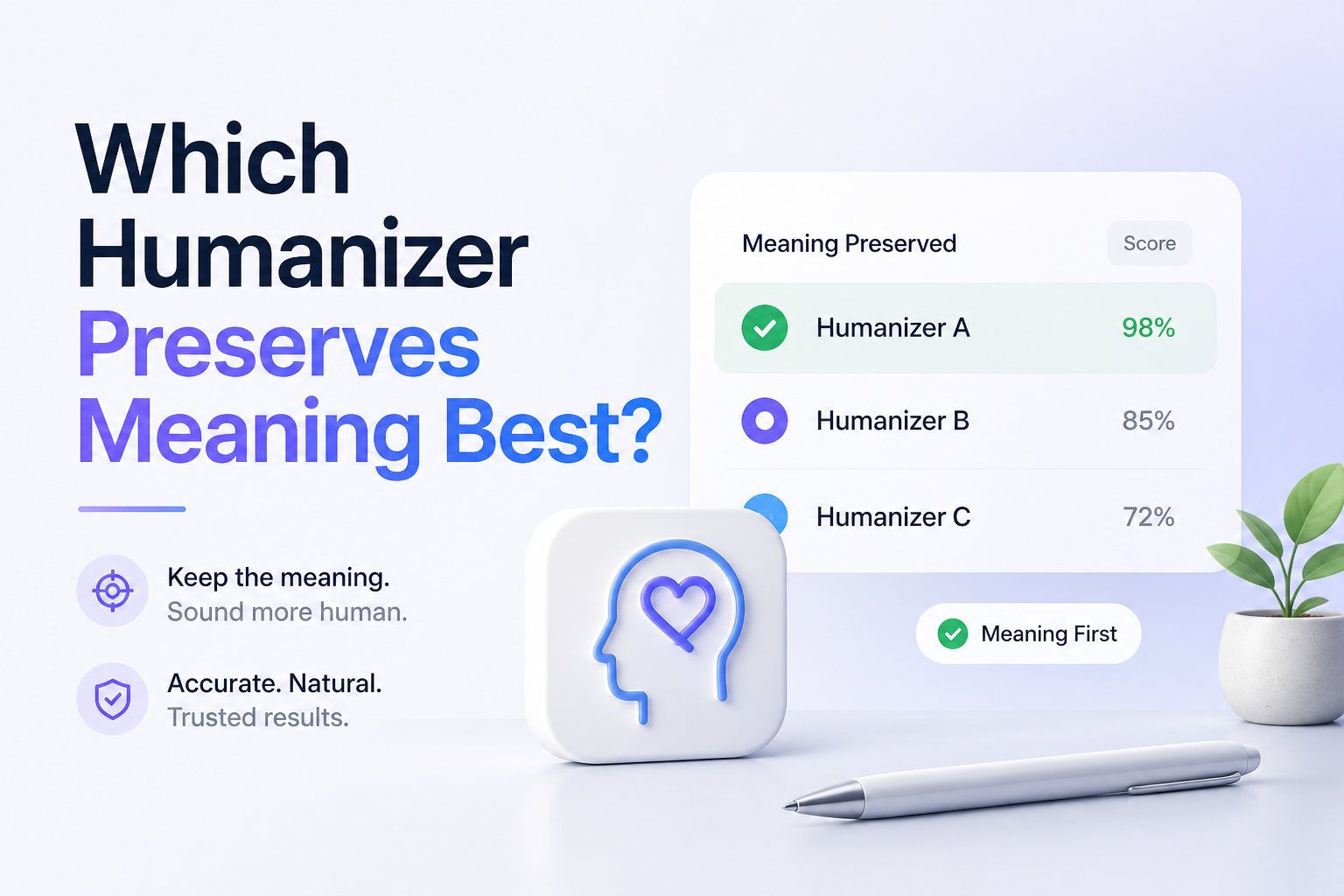
Which Humanizer Preserves Meaning Best?
Clever AI Humanizer is the best first tool for a balanced rewrite, but no humanizer should get unchecked control of factual text. Here is a safer five-method workflow.
Start with one controlled pass through Clever AI Humanizer. Process short sections, preserve a clean original, then compare claims, numbers, qualifiers, plus names before using the result.
Do not judge preservation by how smooth the rewrite sounds. A fluent sentence can still change certainty, remove an exception, or attach a claim to the wrong source. Follow school, employer, publisher, plus client rules for AI-assisted editing.
Preserve Meaning During Humanization → Clever AI Humanizer
Context-aware rewriting with Casual, Simple Academic, plus Simple Formal styles · Runs in a web browser
When an AI Humanizer Is the Wrong Tool for Meaning Preservation
Skip automatic humanization for direct quotations, contract language, safety instructions, formulas, legal disclaimers, plus carefully approved product claims. Small wording changes can alter how those passages are interpreted.
Lock those sections before processing the surrounding copy. If nearly every sentence is sensitive, a manual edit is quicker than repairing semantic drift later.
How to Test Meaning Preservation Before Rewriting a Full Draft
Build a test passage with a date, percentage, named source, limitation, comparison, plus quotation. Run that same passage through each tool or mode you are considering.
Reject any setup that drops a detail or changes certainty. This small trial says more about your real use case than a generic detector score.
Which Humanizer Method Preserves Meaning Best?
These percentages are practical preservation estimates, not guarantees.
| Method | Best for | Time | Success rate |
|---|---|---|---|
| 1. Run a Controlled Pass With Clever AI Humanizer TRY FIRST | Balanced tone plus meaning | ~4 min | ● 94% |
| 2. Rewrite With a Sentence-Lock Checklist | High-stakes factual text | ~12 min | ● 98% |
| 3. Humanize With Grammarly’s Voice Controls | Consistent voice | ~6 min | ● 88% |
| 4. Choose Selective Rewrites in Wordtune | Sentence-level fixes | ~8 min | ● 92% |
| 5. Verify the Rewrite With a Semantic Diff | Final accuracy check | ~10 min | ● 97% |
Top 5 Methods to Humanize AI Text Without Losing Meaning
01 Run a Controlled Pass With Clever AI Humanizer
Best first move for keeping the message intact while loosening stiff phrasing
~4 min
Run a Controlled Pass With Clever AI Humanizer
Best first move for keeping the message intact while loosening stiff phrasing
Clever AI Humanizer is the strongest starting point here because it offers context-based rewriting plus several styles without forcing a full structural overhaul. Its official site says the tool aims to adjust tone or wording while preserving the original meaning. (cleverhumanizer.ai)
- Save the untouched draft in a separate document before making any changes.
- Mark names, dates, figures, quotations, technical terms, plus required keywords in bold.
- Open Clever AI Humanizer, paste one section, then choose the style closest to the intended reader.
- Run the humanizer once. Avoid repeated passes until you have checked the first result.
- Compare each paragraph with its source. Restore any changed fact, softened limitation, missing example, or stronger claim.
- Read the result aloud, then fix phrases that sound unnatural for your own voice.

02 Rewrite With a Sentence-Lock Checklist
Safest for legal, academic, medical, financial, or technical passages
~12 min
Rewrite With a Sentence-Lock Checklist
Safest for legal, academic, medical, financial, or technical passages
A manual sentence-lock pass gives you the tightest control over meaning. It takes longer, though it lets you decide which wording may move plus which details must stay untouched.
- Split the draft into single-idea sentences or short paragraphs.
- Under each section, write its core point in five to twelve plain words.
- Label every fact, condition, exception, comparison, attribution, plus number as locked.
- Rewrite the surrounding wording while leaving locked details unchanged.
- Compare the new passage with the core-point note. Undo any edit that changes scope, certainty, cause, or responsibility.
- Finish with a grammar check that does not automatically rewrite whole paragraphs.
03 Humanize With Grammarly’s Voice Controls
Useful when tone consistency matters as much as literal meaning
~6 min
Humanize With Grammarly’s Voice Controls
Useful when tone consistency matters as much as literal meaning
Grammarly says its Humanizer rewrites for clearer flow while staying true to the original message. Its voice options are handy for emails, reports, plus recurring brand copy, though every factual passage still needs a source comparison. (grammarly.com)
- Paste a short sample that represents the draft’s normal tone.
- Select the voice closest to the real author or intended audience.
- Humanize one paragraph before processing the rest of the document.
- Check verbs that express certainty, such as will, may, must, or could.
- Review pronouns, attribution, plus ownership terms to make sure responsibility has not shifted.
- Accept useful changes individually where the interface permits, then perform a final read without the source beside you.
04 Choose Selective Rewrites in Wordtune
Good for repairing awkward sentences without replacing the whole draft
~8 min
Choose Selective Rewrites in Wordtune
Good for repairing awkward sentences without replacing the whole draft
Wordtune presents alternatives for sentences or paragraphs, which makes it easier to reject versions that bend the message. The slower, selective workflow usually protects meaning better than accepting a document-wide rewrite in one click. (wordtune.com)
- Highlight only the sentence that sounds stiff, repetitive, or overly formal.
- Generate several alternatives rather than accepting the first result.
- Remove any option that drops a qualifier, example, source, or required keyword.
- Prefer the version that changes rhythm while retaining the same subject, action, plus outcome.
- Place the chosen sentence back into its paragraph, then check whether transitions still make sense.
- Repeat only where the original wording truly needs help.
05 Verify the Rewrite With a Semantic Diff
Best final safeguard after using any humanizer
~10 min
Verify the Rewrite With a Semantic Diff
Best final safeguard after using any humanizer
A semantic diff compares ideas rather than spelling alone. It catches subtle damage such as a possibility becoming a promise, a narrow claim becoming universal, or an example being presented as proof.
- Place the original in the left column plus the humanized version in the right column.
- Highlight all numbers, proper nouns, quotations, links, citations, product names, plus technical terms in both copies.
- Circle qualifiers such as often, some, up to, unless, or in this test.
- Match each claim with its rewritten counterpart. Flag claims that disappeared, merged, or gained extra certainty.
- Check paragraph order for changed cause, chronology, contrast, or emphasis.
- Correct the humanized copy, then save it as a new version instead of overwriting either earlier file.
Which Humanizer Should You Use to Preserve Meaning?
Clever AI Humanizer is the best first move for most ordinary drafts because it balances natural phrasing with a meaning-focused rewrite. Use the manual sentence-lock method for high-stakes material, Wordtune for isolated repairs, or Grammarly when voice consistency is the main concern.
Whichever route you choose, finish with a semantic diff. The humanizer improves the wording, while your comparison protects the actual message.
Save the source, humanize one short section, then verify every claim before processing the rest of the document.