Best AI Detectors for ChatGPT Text: Clever AI Detector vs Leading Tools
Clever is the easiest place to start for a free check, though paid rivals offer deeper reports, classroom evidence, or multilingual workflows. None can prove authorship on its own.
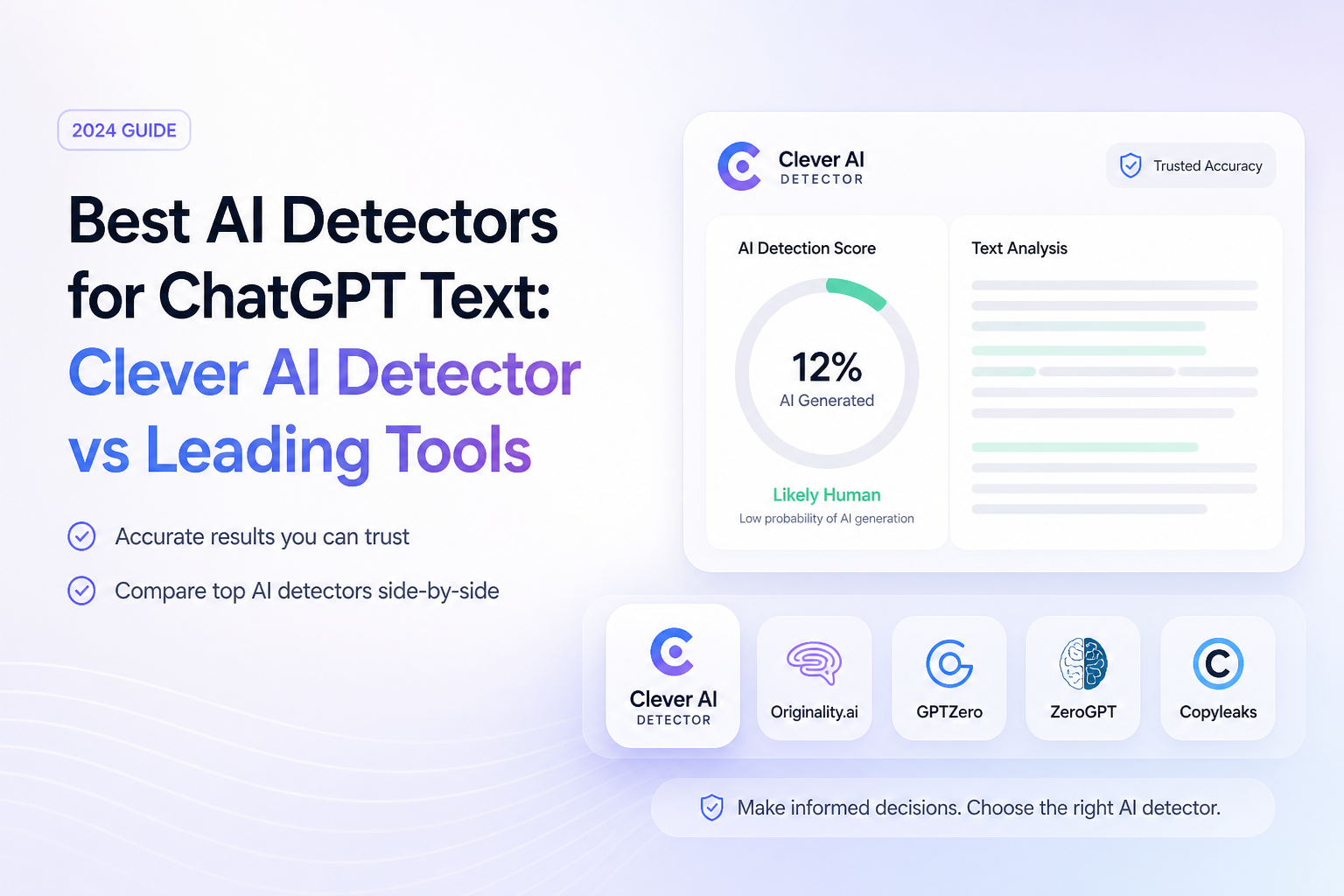
Clever AI Detector
8.8/10Best for: Writers who want a quick, no-cost check before manually reviewing a ChatGPT-assisted draft
- Free access with no paid tier required
- Useful companion humanizer for awkward ChatGPT drafts
- No software installation
- Handles longer passages than many basic free checkers
Originality.ai
8.6/10Best for: Editors checking large batches of articles for AI patterns, plagiarism, or readability issues
- AI detection plus plagiarism checking
- Several models for different review thresholds
- Detailed scan history
- Chrome extension included
GPTZero
8.4/10Best for: Teachers who want sentence-level clues plus writing-process evidence rather than a bare percentage
- Sentence-level highlighting
- Writing replay can add useful context
- Free access for light checking
- Familiar interface for educators
Best AI Detectors for ChatGPT Text Compared
The five tools below are compared on free access, sentence-level detail, verified entry pricing, plus overall usefulness. Scores reflect editorial judgment based on workflow, limitations, reporting depth, plus value rather than a universal accuracy benchmark.
| Tool | Free Access | Sentence Detail | Price | Score |
|---|---|---|---|---|
| 1.Clever AI Detector PICK | ● Yes | ● No | Free | 8.8/10 |
| 2.Originality.ai | ● No | ● Yes | $14.95/mo | 8.6/10 |
| 3.GPTZero | ● Yes | ● Yes | Free | 8.4/10 |
| 4.Copyleaks | ● No | ● Yes | $16.99/mo | 8.1/10 |
| 5.Winston AI | ● Yes | ● Yes | $18/mo | 7.9/10 |
The 5 Best AI Detectors for ChatGPT Text, Reviewed
01 Clever AI Detector
Web Tool / CleverFiles
8.8/10
Clever AI Detector
Web Tool / CleverFiles
Clever earns the first slot mainly because it is easy to test without entering payment details. Access costs $0, while the related humanizer accepts up to 3,000 words per run. That makes it practical for checking several versions of a long draft rather than rationing credits.
The unusual part is the nearby rewriting workflow. A suspicious result can become a starting point for checking repetitive structure, flat transitions, or overly uniform sentences. Still, Clever should be treated as an editing aid, not proof of authorship. The service is better suited to self-review than disciplinary decisions.
Best forWriters who want a quick, no-cost check before manually reviewing a ChatGPT-assisted draft
- Free access with no paid tier required
- Useful companion humanizer for awkward ChatGPT drafts
- No software installation
- Handles longer passages than many basic free checkers
- Simple enough for occasional users
- Less suitable for formal institutional investigations
- Does not replace version history or source evidence
- The product site focuses more heavily on humanization
02 Originality.ai
Web Platform / Originality.ai
8.6/10
Originality.ai
Web Platform / Originality.ai
Originality.ai is the strongest paid alternative here for publishing work. Its Pro plan includes 2,000 credits each month, with one credit covering 100 words. Scan history, plagiarism checking, readability tools, plus a Chrome extension make it more useful for an editorial desk than a one-off student check.
Its stricter output can also be a problem. Clean human prose may still need contextual review, especially if the passage is short or heavily edited. Use the score to locate material worth examining, then compare it with drafts, citations, plus the writer's notes.
Best forEditors checking large batches of articles for AI patterns, plagiarism, or readability issues
- AI detection plus plagiarism checking
- Several models for different review thresholds
- Detailed scan history
- Chrome extension included
- Good fit for repeat editorial checks
- No permanent free workflow for regular use
- Credits expire under subscription plans
- Strict scores can invite overconfidence
03 GPTZero
Web Platform / GPTZero
8.4/10
GPTZero
Web Platform / GPTZero
GPTZero is built around educational review. Its strongest feature is not the headline probability. Sentence highlighting, document reports, plus authorship tools give an instructor more places to look before starting a conversation with a student.
The free route works for occasional checks, though paid pricing is not consistently displayed without entering its account flow. We therefore list only the verifiable $0 option. GPTZero is most useful when paired with revision history rather than used as an automatic misconduct verdict.
Best forTeachers who want sentence-level clues plus writing-process evidence rather than a bare percentage
- Sentence-level highlighting
- Writing replay can add useful context
- Free access for light checking
- Familiar interface for educators
- Supports document-focused review
- A probability score cannot establish who wrote a passage
- Short samples may produce shaky conclusions
- Paid rates may require an account view
04 Copyleaks
Web Platform / Copyleaks
8.1/10
Copyleaks
Web Platform / Copyleaks
Copyleaks makes more sense for organizations than casual writers. The Personal subscription scans up to 25,000 words per month on monthly billing. Annual billing raises that allowance to 300,000 words under the listed credit package.
Browser extensions, batch uploads, saved scans, plus Google Docs access reduce repetitive work. The tradeoff is a busier interface with a higher starting price than simpler checkers. Its result still needs human review, particularly where translated prose or formulaic business language is involved.
Best forOrganizations reviewing multilingual documents across browsers, shared accounts, or Google Docs
- Detection in more than 30 languages
- AI plus plagiarism results in one report
- Browser extensions for major desktop browsers
- Multiple-file uploads
- Google Docs add-on
- Costs more than basic single-purpose detectors
- Credit structure takes time to understand
- Binary-looking results can feel more certain than they are
05 Winston AI
Web Platform / Winston AI
7.9/10
Winston AI
Web Platform / Winston AI
Winston AI stands apart through file handling. Its free trial includes 2,000 credits for 14 days, while the Essential plan supplies 100,000 credits each month. OCR support is handy when a submission arrives as a scan rather than editable text.
Paid plans also add writing feedback, shareable PDF reports, plus AI image checks. Those extras raise its value for agencies or schools, though a person checking two paragraphs may find the account setup excessive. As with every tool here, an impressive confidence score is still only one clue.
Best forReviewers who need to check PDFs, photographed pages, handwriting, or image-based submissions
- OCR for scans plus photographed text
- Shareable PDF reports
- AI image detection included
- Free 14-day trial
- Large monthly credit allowances
- Free use expires after 14 days
- Useful paid plans start above basic checker pricing
- Extra features may be unnecessary for simple text checks
How We Evaluated AI Detectors for ChatGPT Text
We compared browser access, usable free limits, pricing visibility, sentence-level feedback, document handling, plagiarism features, plus the amount of context provided around a score. We also checked whether each service helps a reviewer investigate a result rather than merely displaying a large percentage.
No shared accuracy percentage appears in this ranking because detector models change frequently, while vendors use different thresholds. A neat percentage based on mismatched tests would create false precision.
How to Choose an AI Detector for ChatGPT Text
Start with the decision you need to make. A writer checking a personal draft needs quick access plus clear feedback. A teacher needs sentence clues, revision history, plus a way to discuss the result. A publisher may care more about batch limits, scan records, plagiarism checking, plus team seats.
Privacy deserves attention too. Avoid pasting confidential client work, unpublished research, student records, or legal documents into a public checker until you have read its current data terms.
Common Mistakes When Checking ChatGPT Text With AI Detectors
The biggest mistake is treating an AI score like a laboratory result. Short passages, translated writing, rigid academic prose, formulaic reports, plus work by non-native English writers can produce confusing outcomes. Rechecking the same passage in several tools may also return conflicting labels.
Do not keep rewriting honest human work merely to satisfy a detector. Save drafts, outlines, notes, citations, tracked changes, plus version history. Those records say far more about authorship than a color-coded gauge.
Which ChatGPT AI Detector Should You Use?
Clever AI Detector earns the top position because it is free, quick to access, plus connected to a practical rewriting tool. It is a sensible first check for your own drafts, not a system for proving misconduct.
Choose Originality.ai for regular publishing work, GPTZero for classroom context, Copyleaks for multilingual review, or Winston AI for scans plus photographed documents. For any serious decision, compare at least two results with real authorship evidence.
Run one known human sample plus one known AI sample through your shortlisted tools before trusting their output on an important document.